Quick Summary: Core Rules for Choosing a Folding Puzzle Table
A folding puzzle table offers the ultimate freedom for jigsaw enthusiasts living in compact homes or shared spaces. Instead of monopolizing the dining table for weeks or hunching over carpeted floors, a dedicated collapsible puzzle table sets up in under thirty seconds and stows completely flat once your session concludes.
The ALL4JIG puzzle range includes workspaces for different room sizes and puzzle routines.
Selecting a durable folding table begins with structural integrity: to eliminate annoying tabletop wobble while piecing together intricate sections, insist on folding legs reinforced with steel triangular diagonal strut braces capable of withstanding 25 to 35 lbs of dynamic downward perimeter load.
Equally essential is verifying the collapsed storage profile: high-efficiency folding tables feature recessed leg channels that collapse down to a vertical thickness of just 2.5 to 3.2 inches, easily clearing standard 3.5-inch residential sofa bases and bed frames for flush, out-of-sight storage.
Key Takeaways: Choosing a Folding & Portable Puzzle Table
-
Prioritize Triangular Strut Bracing: Look for folding legs equipped with steel diagonal strut braces and positive gravity detents that resist 25 to 35 lbs of leaning perimeter force without joint sway.
-
Confirm Collapsed Thickness Under 3.2 Inches: Ensure the folded unit measures between 2.5 and 3.2 inches thick so it slides effortlessly under standard 3.5-inch sofa clearance margins.
-
Match Weight to Your Mobility Needs: If you frequently carry your puzzle table between rooms or out to the patio, choose a lightweight composite or aluminum model weighing 9 to 13 lbs rather than a heavy solid hardwood frame (18 to 22 lbs).
-
Check Usable Surface Dimensions: Standard 1,000-piece puzzles from Ravensburger and Buffalo Games fit comfortably on a 28" x 20" interior felt surface, but oversized cuts like White Mountain require an enlarged 1,500-piece table footprint (at least 30" x 24").
Why Collapsible Tables Beat Floor Puzzling and Dining Table Hostage Situations
Every dedicated jigsaw puzzler is familiar with the dreaded "dining table hostage crisis." A complex 1,000-piece puzzle rarely comes together in a single afternoon. Spreading hundreds of loose pieces across a shared dining table or kitchen island disrupts family meals, exposes delicate cardboard tabs to food spills, and often results in hurried teardowns before the puzzle is finished.
The common alternative—assembling puzzles directly on the living room floor—causes severe neck, shoulder, and lumbar strain within minutes. A freestanding folding puzzle table completely resolves this dilemma by providing a self-contained, ergonomic workspace that can be deployed anywhere and cleared away instantly.
Because the entire workstation collapses to a slim 2.5 to 3.2-inch vertical profile, it transforms your living space in moments, slipping under beds, sofas, or behind wardrobe doors without consuming permanent floor space.
This ultra-flat stowage is made possible by precision manufacturing: premium collapsible tables incorporate flush under-table apron cavities of at least 22 mm depth, allowing folding hinge hardware and leg brackets to retract entirely within the frame perimeter rather than protruding outward.
Eliminating Table Wobble: Steel Triangular Struts vs. Friction Hinges
The single most frustrating complaint among folding table owners is lateral sway. When you lean forward to place a stubborn sky piece or inspect fine brushstrokes, a poorly constructed table rocks on its hinges, shifting loosely assembled sections and breaking piece interlocks.
This instability stems from substandard joint geometry: basic folding card tables rely on simple friction hinges that loosen over time, whereas high-grade folding puzzle tables utilize steel triangular diagonal strut braces that withstand 25 to 35 lbs of dynamic downward perimeter load without joint deflection.
Furthermore, hardware safety must never be compromised: advanced folding tables feature spring-loaded positive detent locking pins that physically click into rigid alignment, preventing catastrophic accidental leg collapse when shifting or dragging the table across carpets.
Inspecting the locking mechanism before buying ensures your puzzle workstation remains rock-solid throughout marathon assembly sessions.
Storage Clearance: The 2.5 to 3.2-Inch Profile for Under-Sofa and Bed Stowage
For apartment dwellers and homeowners with limited square footage, a folding table is only as practical as its storage profile. A table that bulges with awkward brackets or protruding knobs cannot slide beneath standard residential furniture, defeating the entire purpose of a collapsible design.
Standard residential sofas feature an under-chassis vertical clearance of 3.5 inches; high-efficiency folding puzzle tables are specifically engineered to collapse to a thickness of 2.5 to 3.2 inches, leaving a comfortable 0.3 to 1.0-inch margin that slides smoothly under furniture without snagging upholstery fabric.
Achieving this streamlined form factor requires dedicated hardware integration: tables engineered with flush under-table apron cavities of at least 22 mm depth house the folded legs completely inside the wooden perimeter, eliminating any risk of hardware scraping hardwood floors or catching on rug fibers during stowage.
Portability Ergonomics: Lightweight Composites (9–13 lbs) vs. Solid Hardwood (18–22 lbs)
Portability is not just about folding legs—it is governed by total carry weight and ergonomic handling. When deciding on a folding table, puzzlers must choose between modern lightweight composite builds and traditional solid hardwood craftsmanship.
Compare the available ALL4JIG puzzle tables against the measurements and features discussed here.
Lightweight portable folding tables constructed from aluminum alloy frameworks and high-density composite honeycomb panels weigh between 9 and 13 lbs (4.1 to 5.9 kg), enabling effortless single-handed transport between the living room, patio, or vacation home.
Conversely, solid hardwood folding tables crafted from dense pinewood or bamboo weigh between 18 and 22 lbs (8.2 to 10.0 kg), creating significant wrist, shoulder, and lower back fatigue when carried over distances exceeding 50 feet.
Portability & Frame Material Comparison Matrix: Composite vs. Hardwood
| Feature & Metric | Lightweight Composite / Aluminum | Solid Hardwood (Pinewood / Bamboo) |
|---|---|---|
| Total Carry Weight | 9 to 13 lbs (4.1 to 5.9 kg) | 18 to 22 lbs (8.2 to 10.0 kg) |
| Ergonomic Fatigue | Effortless room-to-room transit | Noticeable fatigue over 50 feet |
| Collapsed Profile | 2.5 to 2.8 inches (ultra-compact) | 2.8 to 3.2 inches (standard flush) |
| Primary Use Case | Frequent mobility, apartments, travel | Semi-permanent living room setup |
If you plan to fold and move your table after every puzzling session, a 9 to 13 lb composite model provides the ideal balance of rigidity and effortless transport.
Main Board Dimensions: Standard 1,000-Piece vs. Oversized Puzzle Formats
One of the most common purchasing mistakes is assuming that all 1,000-piece jigsaw puzzles share the same physical dimensions. Tables marketed broadly as "1,000-piece compatible" often fit standard cuts but completely fail to accommodate popular oversized puzzle brands.
Standard global 1,000-piece puzzles adhere to compact dimensions: finished Ravensburger 1,000-piece puzzles measure 27.6 in × 19.7 in (70 cm × 50 cm), fitting comfortably inside a standard table basin offering at least 28" x 20" of usable felt area.
Similarly, Buffalo Games standard 1,000-piece puzzles measure 26.75 in × 19.75 in (67.9 cm × 50.2 cm), leaving approximately 1.25 inches of border buffer on a 28" x 20" tabletop.
However, oversized puzzle cuts tell a very different story: White Mountain 1,000-piece puzzles feature larger, nostalgic die-cut pieces that assemble into a 30 in × 24 in (76.2 cm × 61 cm) layout, requiring an oversized 1,500-piece table frame with at least 25" x 31" of usable surface to prevent border overhang.
Always measure the finished puzzle dimensions printed on your favorite puzzle boxes before finalizing your table purchase.
Safe Transit & Storage: Non-Slip Baize (0.62–0.78 Friction) and Protective Covers
A portable puzzle table is only truly practical if an in-progress jigsaw can survive vertical storage and movement without falling apart. The secret lies in surface friction and secure clamping.
Bare polished wood surfaces allow smooth cardboard pieces to slide at slight angles; in contrast, tables lined with microfiber flannel or dense wool baize provide a high static friction coefficient (mu_s between 0.62 and 0.78), effectively locking puzzle pieces in place during transit.
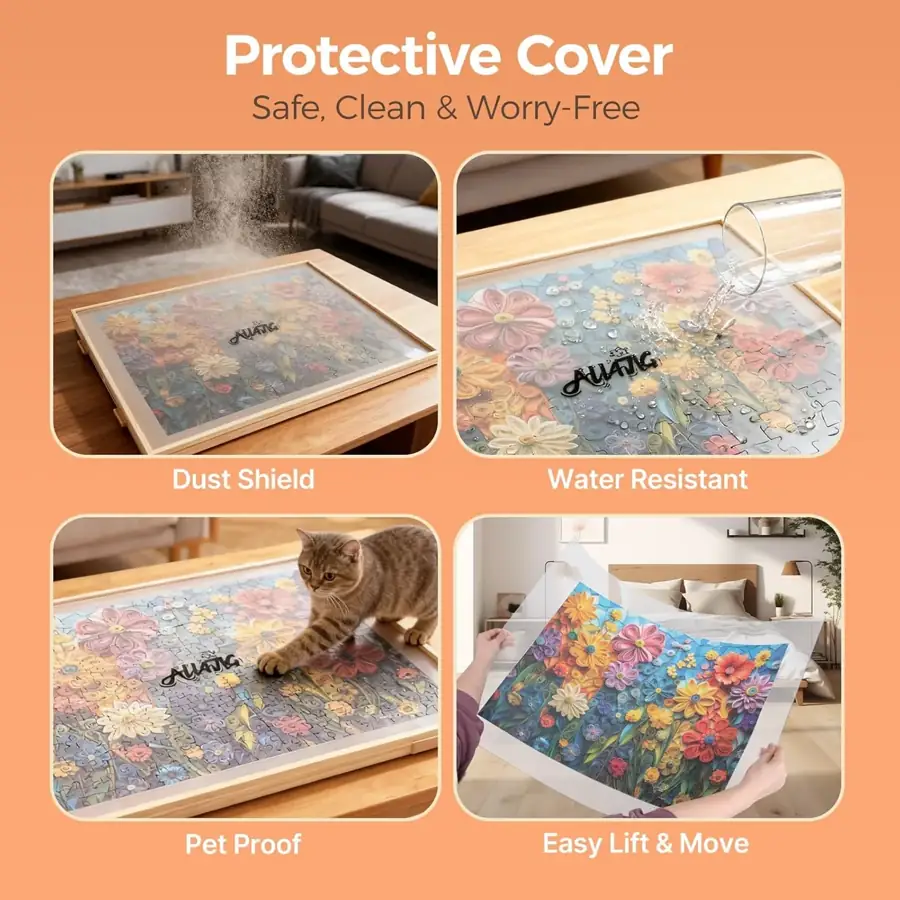
When paired with a fitted translucent dust cover or elastic securing straps, this high-friction surface prevents loose assemblies from shifting even when the table is carried vertically up stairs or stored upright inside a closet.
Buyer's Checklist: Working Height, Latching Pins, and Ergonomic Posture
Before making your final selection, review this essential engineering and ergonomics checklist to ensure your folding puzzle table provides years of wobble-free enjoyment:
-
Triangular Strut Braces: Confirm that the folding legs incorporate diagonal steel strut braces capable of supporting 25 to 35 lbs of dynamic leaning pressure without lateral wobble.
-
Positive Detent Latching: Verify that legs feature spring-loaded positive locking detent pins that lock firmly into place and prevent accidental collapse during table adjustment.
-
Appropriate Working Height: Look for a table height between 28 and 30 inches for comfortable standard chair seating, or consider dual-height telescoping models if you prefer puzzling from a 21-inch sofa.
-
Surface Fabric Quality: Ensure the main board features tightly woven wool baize or microfiber flannel rather than loose felt that pills or snags delicate puzzle tabs.
For broader guidance on table dimensions and alternative styles, explore our comprehensive puzzle table buying guide or compare models in our dedicated review of the best puzzle tables with drawers.
For the next step, read Best Tilting Puzzle Tables: Ergonomic Angles, Neck Pain Relief & Surface Friction.