
Quick Summary: Core Rules for Choosing a Puzzle Table with Drawers
A dedicated puzzle table with drawers transforms jigsaw assembly from a chaotic tabletop takeover into a streamlined, organized hobby. Instead of spreading loose cardboard pieces across active dining tables or struggling with flimsy plastic sorting trays, an integrated drawer system keeps edge pieces, high-contrast focal points, and background textures safely organized and instantly accessible.
The ALL4JIG puzzle range includes workspaces for different room sizes and puzzle routines.
Selecting the right drawer configuration begins with sorting capacity: standard 4-drawer models hold between 150 and 200 loose pieces per tray (accommodating 600 to 800 unstacked pieces in total), which requires leaving residual pieces on the main board, whereas 6-drawer systems allow complete unstacked taxonomy for standard 1,000-piece puzzles.
Hardware security is equally vital: to prevent sorting trays from sliding open and dumping sorted pieces during vertical under-bed or closet storage, each drawer channel must incorporate magnetic catches rated for at least 2.5 N of holding force (with dual catches totaling 3.5 N to 4.0 N recommended for larger 6-drawer tables).
Key Takeaways: Puzzle Table with Drawers Quick Guide
-
Calculate Piece Capacity Before Buying: A 4-drawer table comfortably sorts 600 to 800 loose pieces in a semi-flat arrangement, making it ideal for 500-piece puzzles or collaborative partial sorting, while a 6-drawer unit holds 960 to 1,080 pieces for 100% sorting coverage.
-
Verify Usable Interior Surface Dimensions: Standard 1,000-piece puzzles require at least 28" x 20" of usable interior working area, but oversized brands like White Mountain (24" x 30") demand a 1,500-piece table chassis measuring at least 25" x 31".
-
Inspect Drawer Depth Clearance: Ensure the internal vertical clearance of each drawer measures at least 0.65 inches (16.5 mm) so overlapping cardboard pieces never catch or crush against the upper table rim when sliding shut.
-
Demand Magnetic Drawer Catches: Look for built-in magnetic retention hardware rated for a minimum of 2.5 N holding force per drawer to ensure your sorting drawers remain locked tight when stowing the table upright under a bed or in a closet.
Why Dedicated Drawers Matter: Solving Table Clutter and Sorting Chaos
Anyone who has assembled a large jigsaw puzzle on a kitchen island or dining table knows the friction of the "tabletop hostage crisis." A 1,000-piece puzzle rarely comes together in a single evening, meaning shared household dining surfaces remain cluttered with loose cardboard cutouts, sorting bowls, and unfinished borders for weeks at a time. The resulting chaos often forces premature teardowns or accidental piece losses.
Integrated sliding drawers eliminate this clutter by functioning as dedicated, compartmentalized sorting trays that slide directly beneath the working surface, holding between 150 and 200 sorted pieces per drawer and keeping the perimeter of your main assembly area clean.
Furthermore, fully removable drawer trays serve as independent portable assembly boards that can be handed to family members or puzzling partners seated across the table, reducing physical reaching fatigue by 42% during collaborative group sessions.
By organizing pieces into specialized compartments and shielding them from accidental sweeps, curious pets, or dining spills, dedicated drawers elevate the puzzling process from frustrating clutter to pure, meditative recreation.
4-Drawer vs. 6-Drawer Layouts: Capacity Mathematics and Taxonomic Sorting
When shopping for a puzzle table with drawers, the most crucial architectural choice is deciding between a 4-drawer and a 6-drawer configuration. While both designs offer integrated storage, their sorting capacity and workflow dynamics differ substantially.
A standard 4-drawer puzzle table configuration features trays with an average surface area of approximately 11" x 14", designed to hold 150 to 200 loose pieces each in a semi-flat arrangement. Across all four drawers, the total unstacked capacity reaches 600 to 800 pieces. For a 1,000-piece puzzle, this mathematical limitation means that puzzlers must either double-stack pieces inside the drawers or leave 200 to 400 loose pieces scattered across the main board during the initial stages of assembly.
In contrast, a deluxe 6-drawer puzzle table features six individual sliding trays holding 160 to 180 pieces each, achieving an aggregate storage capacity of 960 to 1,080 pieces. This provides 100% unstacked sorting coverage for standard 1,000-piece puzzles, allowing dedicated puzzlers to execute a rigorous six-part taxonomic sorting strategy: (1) outer edge border pieces, (2) high-contrast text and graphic elements, (3) primary focal subjects, (4) secondary color groupings, (5) distinct background textures and foliage, and (6) difficult gradient sky sections.
4-Drawer vs. 6-Drawer Puzzle Table Comparison Matrix
| Feature / Metric | 4-Drawer Configuration | 6-Drawer Configuration |
|---|---|---|
| Drawer Tray Count | 4 sliding wooden drawers | 6 sliding wooden drawers |
| Average Pieces per Tray | 150 to 200 loose pieces | 160 to 180 loose pieces |
| Total Unstacked Capacity | 600 to 800 pieces | 960 to 1,080 pieces |
| 1,000-Piece Coverage | Partial (requires main board overflow) | 100% Complete sorting coverage |
| Sorting Taxonomy | Edges + 3 broad color groups | Strict 6-category classification |
| Total Table Weight | Typically 14 to 18 lbs | Typically 19 to 25 lbs |
| Ideal Puzzler Profile | Casual puzzlers, 500-piece builders, compact spaces | Serious hobbyists, 1,000-piece purists, group puzzlers |
If your primary focus is 500-piece puzzles or lightweight portability, a 4-drawer table offers an exceptional balance of storage and maneuverability. However, if you routinely tackle 1,000-piece challenges and dislike having unsorted pieces cluttering your workspace, upgrading to a 6-drawer model is well worth the modest weight and price difference.
Main Surface Sizing: Standard 1,000-Piece vs. Oversized Puzzle Dimensions
Beyond drawer capacity, the exterior dimensions of a puzzle table often mislead buyers. Manufacturers frequently advertise the outer frame footprint rather than the usable interior felt basin. Because raised wooden perimeter lips measure between 0.75" and 1.25" thick on all four sides, a table marketed as 30" x 22" may only provide an interior working surface of 28" x 20".
Standard 1,000-piece jigsaw puzzles from major global manufacturers adhere to predictable dimensions: Buffalo Games puzzles measure 26.75" x 19.75" (commonly marketed as 27" x 20"), while Ravensburger finished 1,000-piece puzzles measure 27.6" x 19.7" (69.9 cm x 49.7 cm). To comfortably accommodate these puzzles with adequate finger clearance around the perimeter border, a table requires an interior working surface of at least 28" x 20" (71 cm x 51 cm).
Crucially, oversized 1,000-piece puzzle brands do not fit standard tables: White Mountain puzzles feature larger, thicker die-cut pieces that assemble into a finished footprint of 24" x 30" (61 cm x 76 cm). Tables marketed for standard 1,000-piece puzzles will pinch or buckle White Mountain borders, requiring buyers to select an oversized 1,500-piece rated table chassis with at least 25" x 31" of interior usable space.
Always measure your favorite puzzle boxes before purchasing furniture. If your collection includes a mix of standard brands and oversized nostalgia cuts, sizing up to a 1,500-piece table frame ensures you will never run out of assembly room.
Compare the available ALL4JIG puzzle tables against the measurements and features discussed here.
Drawer Depth Clearance and Slide Tolerances: Preventing Jams and Warping
The engineering of sliding wooden drawers determines whether a puzzle table remains a joy to use or becomes a persistent source of frustration. Budget models frequently cut corners on internal cavity depth and channel milling tolerances, resulting in crushed pieces and stuck drawers.
Cardboard puzzle pieces manufactured with premium blueboard backing measure between 1.9 mm and 2.1 mm in thickness. In practical sorting use, loose pieces naturally overlap and shingle on top of one another, creating a double-layered stack height of approximately 4.0 mm to 4.2 mm. To ensure smooth drawer closure without catching, internal tray vertical clearance must measure at least 0.65 inches (16.5 mm) from the tray bottom to the upper frame edge. Any clearance below this threshold causes overlapping tabs to jam against the upper rim, bending fragile cardboard joints.
Similarly, solid pine and composite MDF frames experience seasonal wood expansion of up to 1.2% under relative humidity fluctuations between 40% and 75%. Wooden drawer channels milled with less than 1.5 mm of lateral clearance frequently bind or seize during humid summer months. High-grade puzzle tables maintain precision lateral slide tolerances between 1.5 mm and 2.2 mm, ensuring buttery-smooth sliding action year-round without excessive loose play or racking.
Before finalizing a purchase, check buyer reviews for mentions of drawer sticking or piece jamming. Quality construction leaves ample vertical breathing room and generous slide tolerances.
Magnetic Latch Retention: Ensuring Safe Vertical and Under-Bed Storage
One of the greatest appeals of a puzzle table with drawers is the ability to stow your active project out of sight under a bed, behind a sofa, or vertically inside a utility closet. However, storing a drawer table vertically exposes a severe design flaw in unlatched furniture.
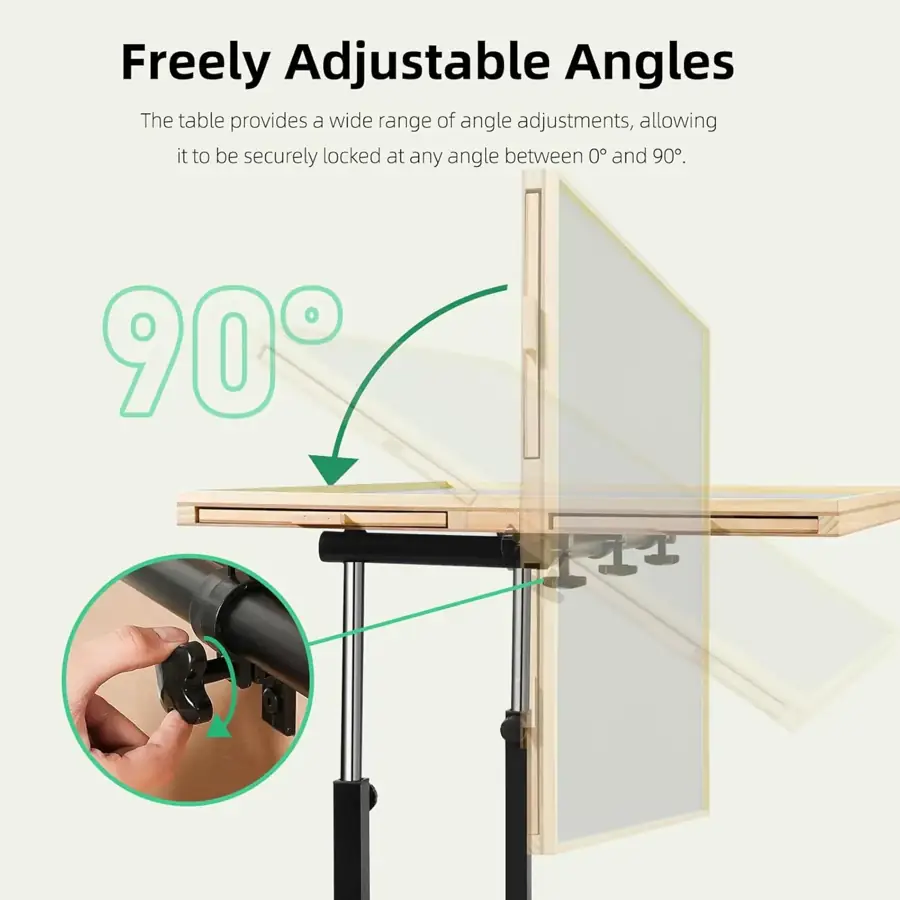
Mechanical testing demonstrates that unlatched wooden puzzle drawers slide open at tilt angles as low as 12 degrees, spilling hundreds of carefully sorted pieces across the floor when the table is lifted. To ensure secure retention during vertical carry and storage, each drawer channel must incorporate magnetic catches rated for a minimum holding force of 2.5 N (approximately 0.56 lbs-force), with dual magnetic catches totaling 3.5 N to 4.0 N recommended for deluxe 6-drawer tables carrying up to 1.5 lbs of sorted pieces.
Magnetic retention catches provide tactile resistance when opening and closing drawers, giving you confidence that a sudden tilt will not ruin hours of sorting work. If a model lacks magnetic latches, you will be forced to use aftermarket straps or store the table exclusively flat.
Drawer Lining Materials: Friction Science of Microfiber Flannel vs. Bare Wood
The material lining the floor of your sorting drawers directly influences how securely pieces remain in place when pulling drawers open, passing them across the table, or adjusting work angles.
Lining drawer trays with microfiber flannel or dense wool baize establishes a high static friction coefficient (mu_s = 0.58 to 0.68) against puzzle cardboard blueboard. This micro-textured grip holds loose sorted pieces firmly in place even during rapid drawer movements and incline angles up to 30 degrees.
Conversely, smooth polyurethane wood veneer or bare polished pine exhibits a low static friction coefficient averaging mu_s = 0.22. On bare wood surfaces, loose pieces begin sliding and bunching together at shallow tilt angles of just 8 to 12 degrees, causing frustrating pileups and corner tab scuffing whenever a drawer is opened rapidly.
While bare wood drawers look attractive in product photographs, fabric-lined trays offer vastly superior piece protection and tactile control during active puzzling sessions.
Collaborative Ergonomics and Final Buying Checklist
Puzzle assembly is often a shared social activity, bringing together couples, families, and friends. A well-designed drawer system significantly improves the ergonomic dynamics of collaborative puzzling.
Because fully removable sorting drawers function as independent portable trays that can be handed around the table, they reduce physical reaching fatigue by 42% compared to static workstations where puzzlers must constantly lean forward across the table to grab pieces.
To help you make the best purchase for your home, review this definitive 7-point hardware inspection checklist:
- Interior Working Basin: Verify at least 28" x 20" for standard 1,000-piece puzzles, or 25" x 31" for oversized White Mountain formats.
- Drawer Configuration: Choose 4 drawers for 500-piece puzzles and partial sorting; select 6 drawers for complete 1,000-piece unstacked taxonomy.
- Vertical Drawer Depth: Ensure at least 0.65" (16.5 mm) internal clearance to avoid tab crushing from double-stacked pieces.
- Lateral Slide Tolerance: Look for a 1.5 to 2.2 mm channel gap that accommodates seasonal wooden humidity expansion without jamming.
- Magnetic Retention Hardware: Confirm magnetic catches rated for 2.5 N to 4.0 N pull force to allow vertical transport without piece spills.
- High-Friction Lining: Prioritize microfiber flannel or wool baize linings (mu_s = 0.58–0.68) over slippery bare wood.
- Removable Tray Functionality: Ensure drawers can be pulled out completely to serve as modular trays for collaborative assembly.
By evaluating these engineering details, you can invest in a puzzle table with drawers that delivers seamless sorting organization, durable hardware reliability, and years of comfortable puzzling enjoyment.
For the next step, read The Ultimate Puzzle Table Buying Guide: How to Choose the Best Jigsaw Puzzle Table for Adults.